Keely Hallinan
Public Relations Professional


UGA student works part-time to pay for rising fraternity dues
By Keely Hallinan
April 2023
Why I Wrote the Story
Kiefer Sturisky represents a crucial demographic: full-time students working part-time to stay involved in a university's greek life. The intimate experience of looking into Sturisky's life taught me more about interviewing, personal boundaries and objective writing than I could have ever thought to experience. I am grateful for a new set of lenses into the reality of inflation and its effects on college students.
Kiefer Sturisky sighs and grabs his backpack at the Alpha Epsilon Pi house on a sunny afternoon. He heads to Skoolers Tutoring, where he will work a three-and-a-half-hour shift despite having a test in his finance class the next morning.
But Sturisky said it is worth it.
Kiefer Sturisky, a part-time employee and student at the University of Georgia, works a three-and-a-half-hour shift at Skoolers Tutoring. Sturisky usually works in the afternoon after his classes. (Photo/Keely Hallinan)
The second-year student at the University of Georgia handles the balance between school and part-time work in order to pay for half of his greek life dues. AEPi dues have increased over the last year by 10% as housing prices in Athens have risen and inflation continues to impact the cost of living.
The Zillow Home Values Index shows the average Athens home value is $290,264, which is up 7.3% over the past year. The US Inflation Calculator shows a 5% inflation rate, which has lowered since January 2023 but remains high compared to 2021’s average rate of 1.4%.
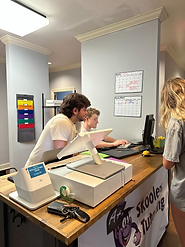
Sturisky and his coworker exchange information for a tutoring packet with a customer. Skoolers Tutoring is an Athens educational center that provides students with additional explanations and practice for certain UGA courses. (Photo/Keely Hallinan)
AEPi Treasurer Simon Klee, a second-year management information systems major at UGA, said the dues for this year are $1,900 per semester compared to last year’s $1,750 per semester. The fraternity has seen the impact of inflation firsthand. Klee said venues for date nights have been the most notable cost difference.
“When we had to raise dues this semester, I had conversations with members like Kiefer,” Klee said. “They struggle. They approached me and they didn’t think they could pay the amount.”
The concern of rising dues is troubling for Sturisky.
A deal stands with his parents if he works part-time and spends his income, he can participate in a fraternity and live at the fraternity house for a year. Sturisky picked up more shifts this semester to cover the additional due costs.
Sturisky works an average of 14 hours a week and is enrolled in five courses at UGA as a co-major in international business and management information systems.
“I didn’t think it would be so time-consuming,” Sturisky said. “But since it is, it’s very frustrating knowing that I have this responsibility when I have so much work I have to do at the same time.”
Researchers at the University of Tennessee reported students who work while enrolled in college are about 20% less likely to complete their degrees than peers who do not work, which shows a decrease in predicted graduation rates. Sturisky said he puts his Skoolers job ahead of his studies but knows his school should come first.
Skoolers Tutoring has two locations, one in Athens and another one in Tallahassee, Florida. Sturisky said his job consists of printing tutoring packets, packaging the packets, sorting orders per academic course and dispersing packets to customers.
Despite the overwhelming school and work balance, Sturisky said living in the house and being a fraternity member is worth it because he is “paying to live with 31 of my best friends.”
Alpha Epsilon Pi, located off River Road, is home to Sturisky and 31 other fraternity members. The chance to live at AEPi is what motivates Sturisky to work part-time while being a full-time student. (Photo/Keely Hallinan)
The North American Interfraternity Conference reports nearly 80% of fraternity men report excellent-to-good mental health and well-being.
“That’s the whole reason I decided to get the job and do greek life is so I could have that close relationship with so many people,” Sturisky said. “And, you know, I would pay even more just to be able to live with all of them.”
Now that he’s almost finished sophomore year, he recognizes the challenges he will face next year. He will live in a five-bedroom apartment at The Mark, close to downtown, and it costs $1,200 per resident, including utilities but excluding parking. At least this year, parking was free for him.
“The parking itself is ridiculous,” Sturisky said. “$75 a month for parking.”